A dense Bomarea multiflora cluster has long red flowers with dark spots inside their flared mouths among narrow green leaves

Bomarea multiflora (Trailing Lily)


Native to Colombia and Ecuador, this perennial twining vine has tuberous roots and can climb about 10 feet. In Colombia, it occurs in the Andes and Sierra Nevada de Santa Marta between about 5,600 and 12,500 feet. Its narrow leaves accompany hanging clusters of tubular flowers in red, orange, and yellow, often marked with dark spots. Capsules split open to expose fleshy orange-red seeds dispersed by birds. It also spreads from underground stems. It is invasive in New Zealand, where it smothers native forest and shrubland vegetation and prevents seedlings from establishing. Photographed in the Andes of Colombia.

A rounded Bomarea multiflora cluster has pink-red tubular flowers with dark spots inside their flared mouths
Bomarea multiflora flowers have yellow-orange inner tepals densely marked with dark spots beneath broad green leaves
Three red Bomarea multiflora flower clusters hang among the pointed green leaves of a climbing vine
Two hanging Bomarea multiflora clusters have red tubular flowers with dark markings inside their yellow-orange mouths
Bomarea multiflora flowers radiate from purple stalks, with pink outer tepals and dark-spotted orange inner petals
A close view of Bomarea multiflora flowers shows dark-spotted yellow inner petals, yellow filaments, and dark anthers
A Bomarea multiflora cluster hangs from a curving stem, with pink-red flowers and dark-spotted orange inner petals
Long red Bomarea multiflora flowers hang from radiating dark stalks beneath narrow, twisted green leaves
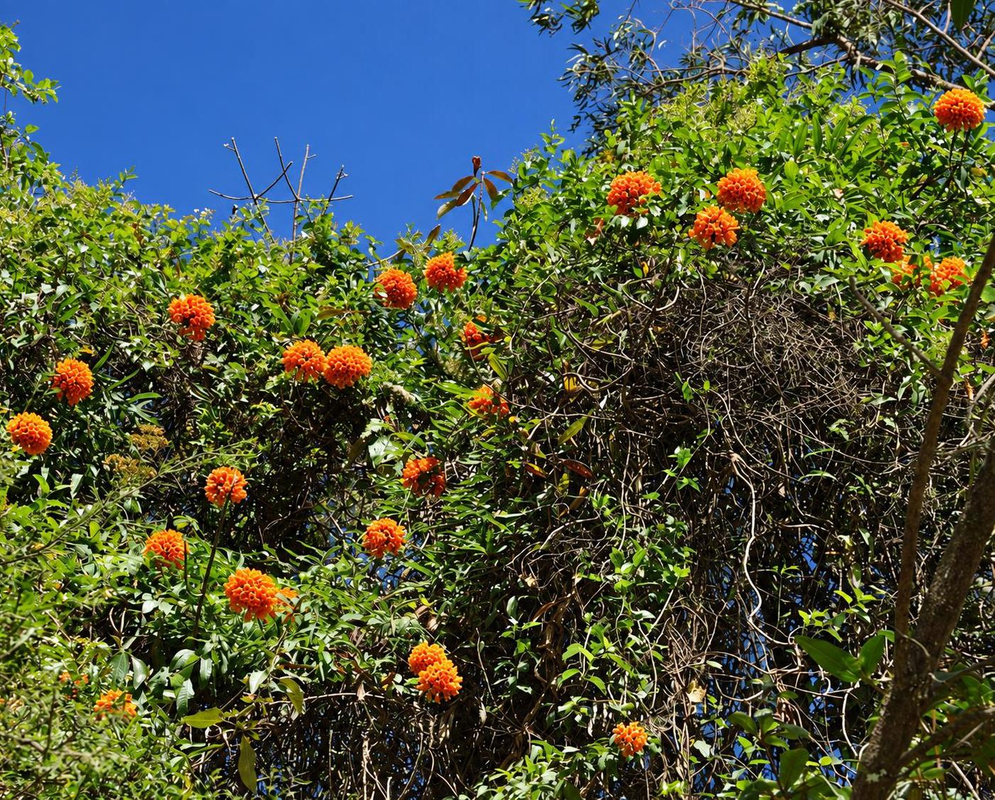
Bomarea multiflora forms a climbing mass covered in rounded orange flower clusters

Privacy Policy, Legal Notices and Copyright 2016-2026. Engage the Exotic TM, All Rights Reserved.