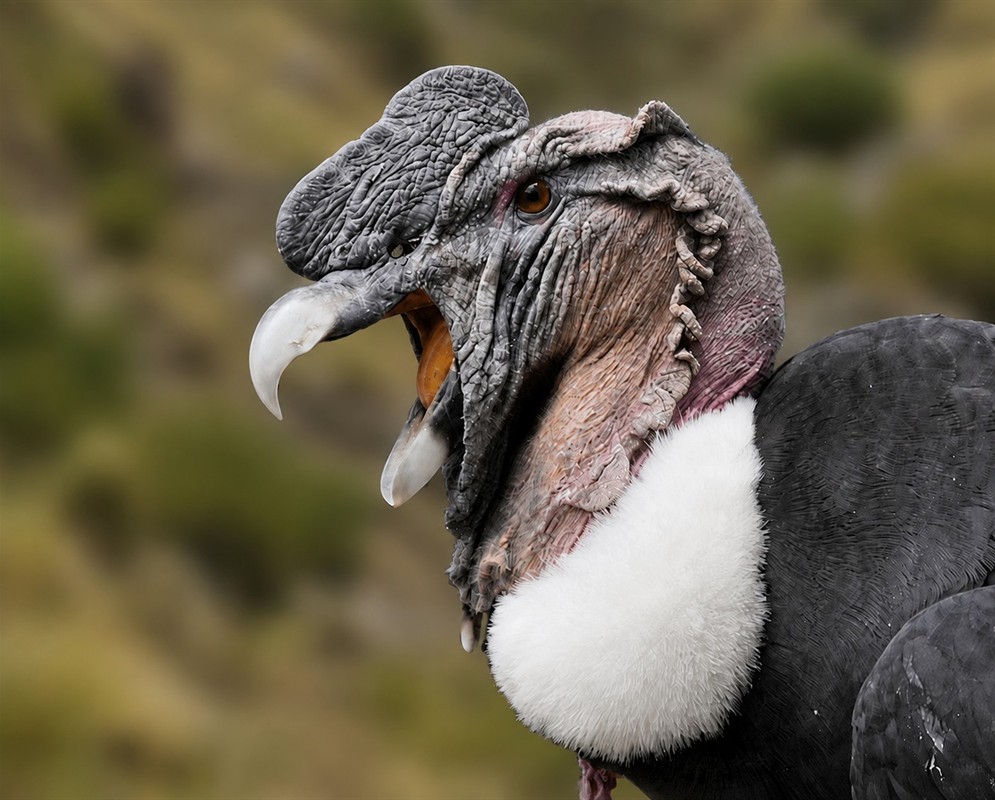


Vultur gryphus (Andean condor)
Vultur gryphus (Andean condor) ranges along western South America from Colombia and Ecuador through Peru and Bolivia to Chile and Argentina. It occupies open mountains, high grasslands, deserts, and coastal cliffs where rising air allows efficient soaring. Adults are among the world’s heaviest flying birds and can span more than ten feet across the wings. Both sexes have black plumage, a white neck ruff, and broad white areas on the upper wings. Adult males are larger and carry a fleshy comb on the head, while females lack the prominent comb. Juveniles are brownish and acquire adult plumage gradually.
The species is primarily a scavenger, locating carrion while gliding across extensive areas with little flapping. Condors gather at large carcasses but also roost communally on protected cliff ledges. A breeding pair normally lays a single egg on a bare ledge or in a shallow cave. Both parents incubate and feed the chick, which develops slowly and may remain dependent long after fledging; this low reproductive rate limits population recovery. BirdLife International and the IUCN classify the Andean condor as Vulnerable. Major threats include deliberate poisoning, secondary poisoning from poisoned carcasses, lead exposure, persecution, collisions with infrastructure, and disturbance near roosting and nesting sites. The bird has exceptional cultural importance throughout the Andes and is a national symbol of several South American countries. Research-grade iNaturalist observations document it in Colombia, Ecuador, and Peru. Photographed in Colombia.