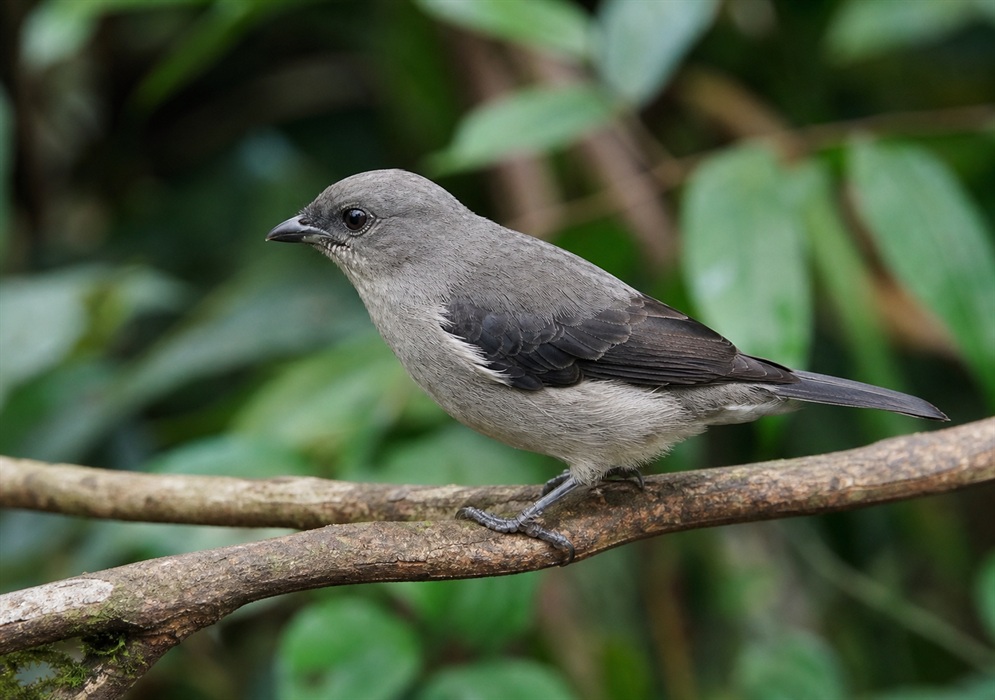


Tangara inornata, commonly known as the Plain-colored Tanager, occurs from Costa Rica through Panama into northwestern Colombia. It inhabits humid lowland and foothill forest, forest borders, tall secondary growth, and wooded clearings, generally below about 4,000 feet. The bird is compact, with subdued grayish olive plumage, paler underparts, dark wings, and a bluish cast that can be more noticeable in good light. Its restrained coloring distinguishes it from many brightly patterned members of the same genus.
Plain-colored Tanagers usually travel in pairs or small groups and frequently join mixed-species feeding flocks in the canopy and along forest edges. They take small fruit and arthropods, searching among foliage and making short flights between fruiting trees. Their social movements can bring several individuals together at a productive food source, while pairs maintain contact with thin calls. During feeding, they often inspect clusters of leaves and fine branches rather than remaining exposed for long. Their muted plumage can make them difficult to separate from foliage until movement reveals the flock. The species uses modified habitats when trees remain, including mature secondary forest and shaded plantations, but it is most closely associated with wooded landscapes. It has a broad enough distribution and population to be assessed as Least Concern. Photographed in Colombia.