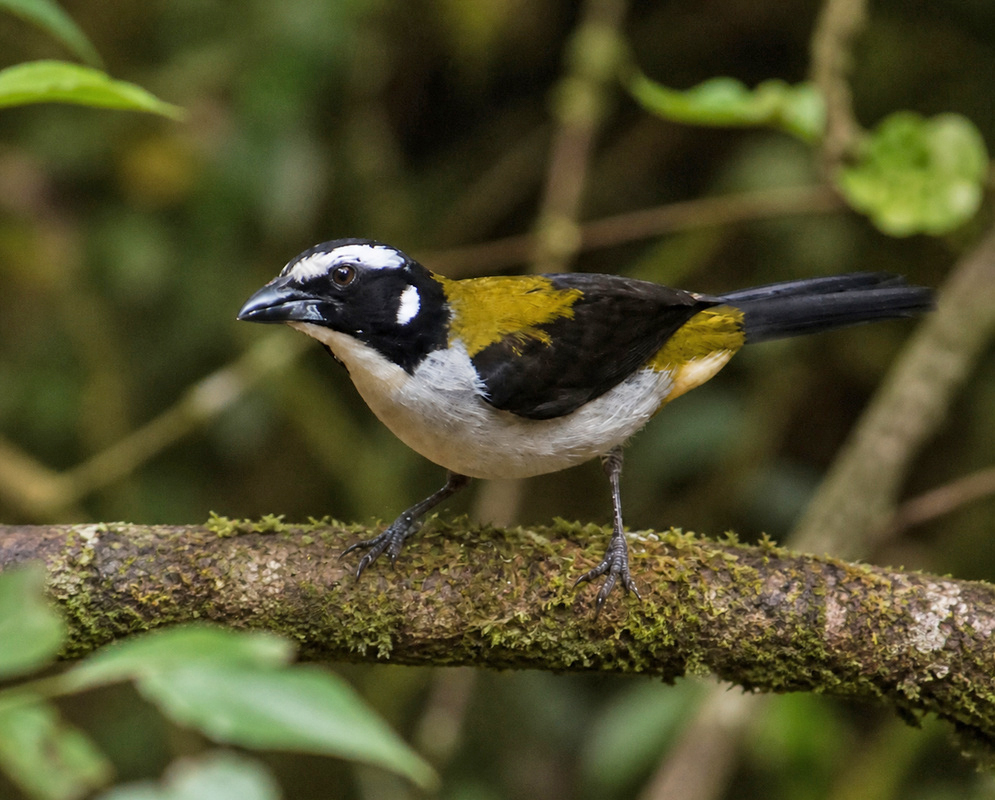


Saltator atripennis (Black-winged saltator)
Saltator atripennis (Black-winged saltator) is resident on the western and central Andean slopes of Colombia and western Ecuador. It lives in humid montane forest borders, secondary growth, shaded plantations, gardens, and other wooded habitats, generally at middle elevations. The bird is approximately eight inches long and has the heavy, slightly curved bill typical of a saltator. A gray head and breast contrast with darker wings and tail, while a bright yellow patch in the wing is conspicuous when the feathers spread. Olive tones occur across the back, and bold facial markings frame the pale throat.
Individuals are usually found in pairs or small groups and may join mixed-species feeding flocks along forest edges. They move deliberately through shrubs and trees, taking fruit, seeds, buds, flowers, and tender plant material, while also consuming some invertebrates. The powerful bill handles firm fruit and seeds, but the species often feeds quietly inside foliage rather than on exposed ground. Its song contains clear, whistled phrases delivered from a branch, and calls help pairs remain in contact as they forage. Nesting information is less extensive than for many widespread saltators, although a documented nest in northwestern Ecuador adds evidence about breeding behavior within its restricted Andean range. The IUCN classifies the species as Least Concern, but its distribution is substantially narrower than that of several familiar congeners. Photographed in Colombia.