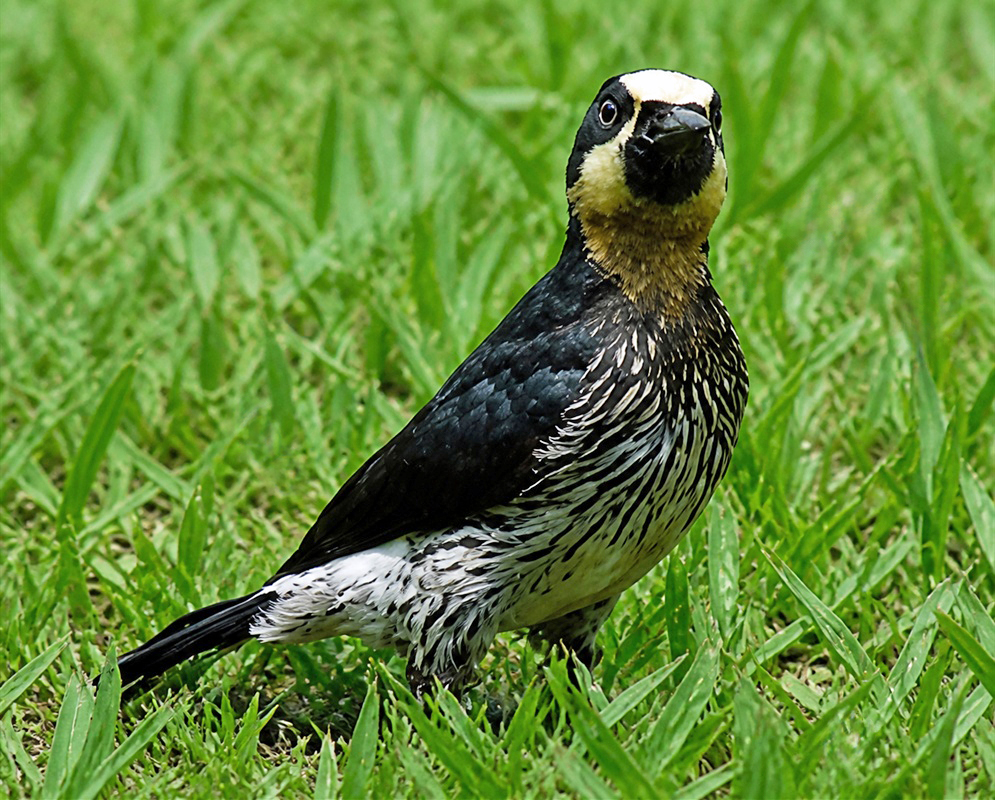


Melanerpes formicivorus (Acorn woodpecker)
Melanerpes formicivorus (Acorn woodpecker) occurs in separated populations from the western United States through Mexico and Central America to the northern Andes of Colombia. It is closely associated with oak woodland but also uses pine-oak forest, open montane woodland, and settled landscapes containing mature trees. Adults are about eight and one-half inches long, with glossy black upperparts, a white forehead and rump, pale eyes, and a red crown. White wing patches flash in flight. Colombian birds differ somewhat in facial pattern from many northern populations but retain the contrasting black, white, and red appearance.
The species is best known for granaries: trees, wooden poles, or buildings containing hundreds or thousands of individually drilled holes in which acorns are stored. Birds move shrinking nuts into tighter holes, defend the store, and draw upon it when insects and fresh foods are scarce. Family groups may include multiple breeding males and females plus nonbreeding helpers. Group members jointly defend a territory, excavate cavities, incubate eggs, and feed young. This cooperative system can also involve competition within the group, including the removal of eggs laid before females begin laying in synchrony. Food includes acorns, other fruit, sap, flower nectar, and insects caught on bark or in the air. The IUCN classifies the species as Least Concern because it has a broad range and remains locally common where suitable oak habitat and nesting trees persist. Photographed in Colombia.