

Jacana jacana (Wattled Jacana)
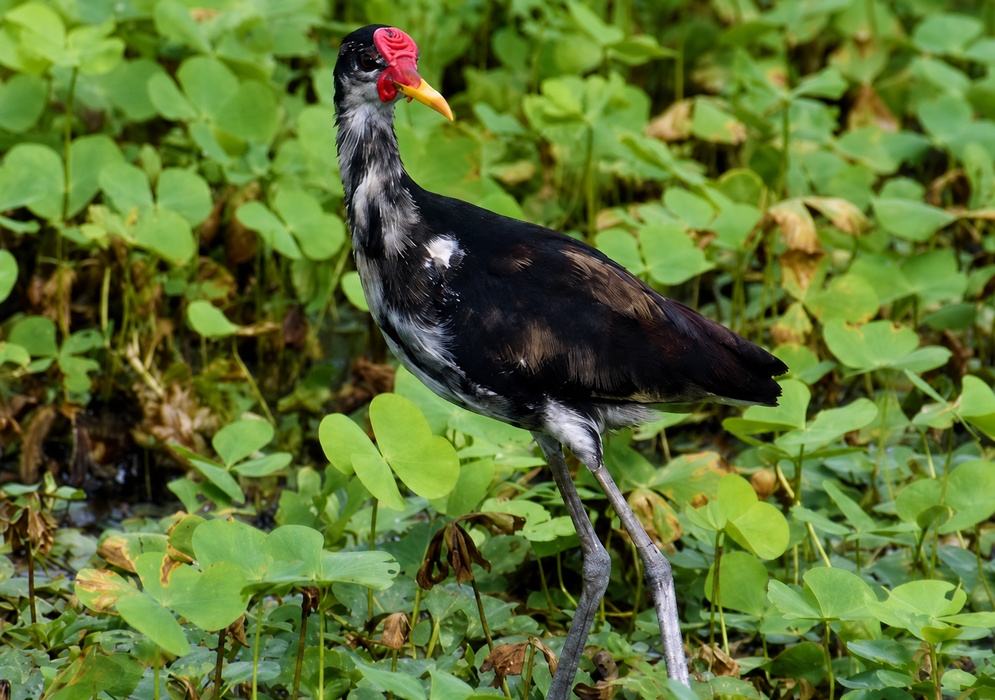
Jacana jacana (Wattled Jacana) is a resident wetland bird distributed from Panama and Trinidad through much of tropical South America, including Colombia, Venezuela, the Guianas, Brazil, Ecuador, Peru, Bolivia, Paraguay, Uruguay, and northern Argentina. It inhabits freshwater marshes, shallow lagoons, ponds, flooded grasslands, and slow-moving waterways where floating or emergent vegetation is abundant. Exceptionally long toes spread the bird’s weight across lily pads and other aquatic plants, allowing it to walk over surfaces that would not support most birds of similar size.
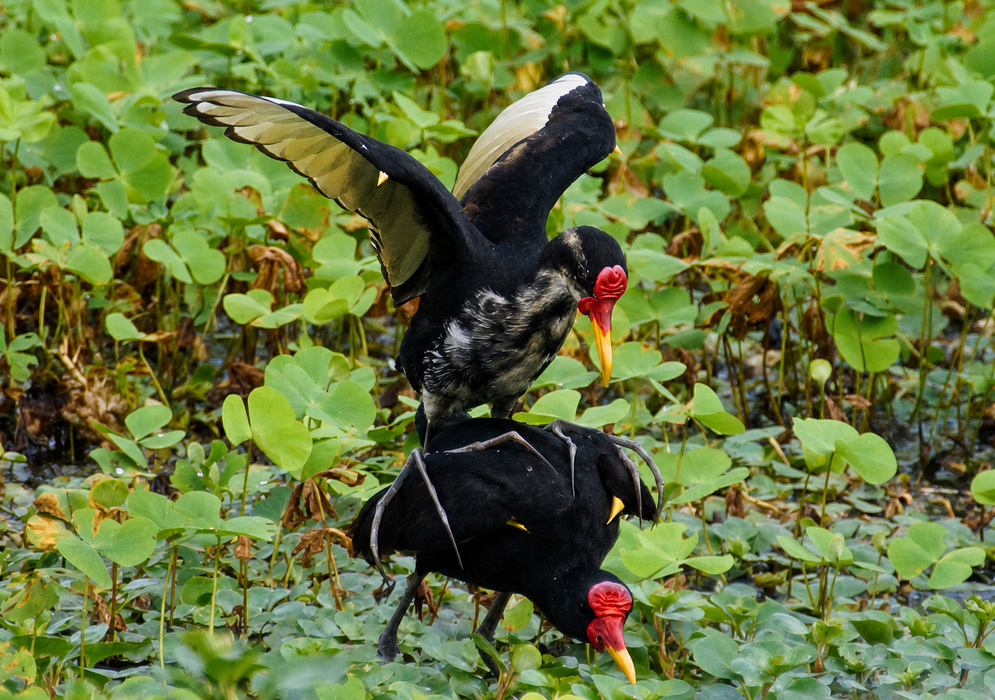
Adults have dark underparts, a red frontal shield and wattle at the bill base, and yellow flight feathers that become conspicuous when the wings open. Back color varies geographically from chestnut to nearly black. Young birds begin with bronzy-brown upperparts, white underparts, a pale eyebrow, and a yellow bill, gradually acquiring darker adult plumage and the red facial shield. The diet includes aquatic insects, other small invertebrates, seeds, and plant material collected from vegetation and the water surface.
The breeding system is often polyandrous: a female may defend a territory containing several males, while each male incubates a clutch and cares for the chicks. The male can shelter small chicks beneath his wings and may carry them away from danger with their legs hanging between his body and wings. Chicks leave the nest soon after hatching and can move across wetland vegetation, but they remain under male protection. Photographed in Colombia.