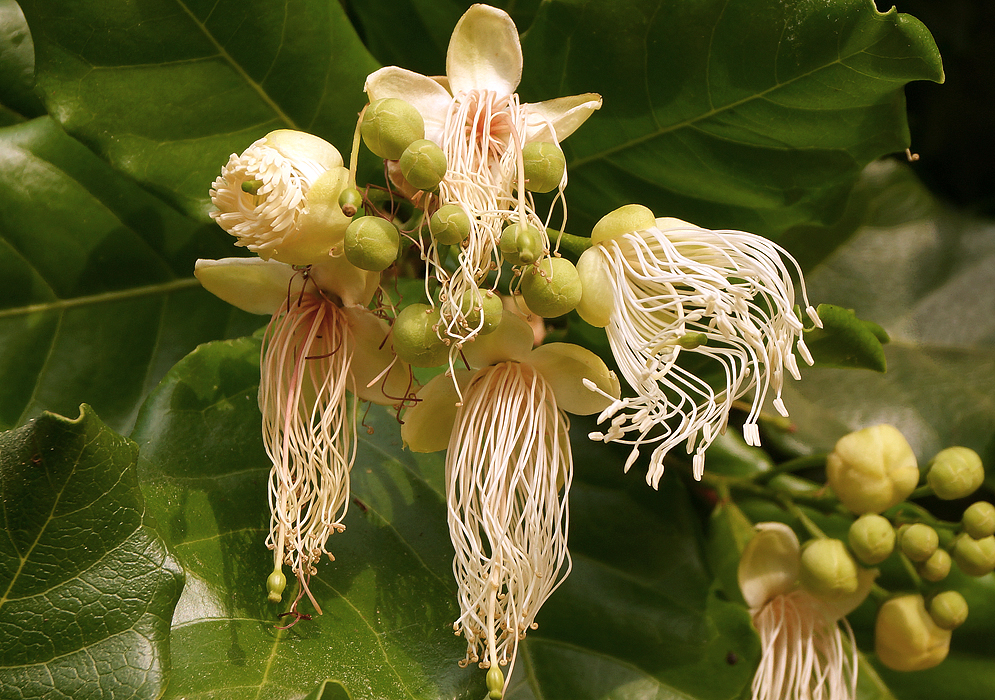


Morisonia hastata (Cynophalla hastata)
Native to the Caribbean, Colombia, Venezuela and eastern Brazil, Morisonia hastata is an evergreen tree of seasonally dry tropical forests. In Colombia, it grows on the Caribbean plain from near sea level to about 2,800 feet. Its flowers have four cream-colored petals surrounded by numerous long stamens, with wine-red bases and white tips. The flower buds are angular, and rounded nectar glands occur just above the leaf axils. The elongated fruits develop slight constrictions between the seeds. When ripe, the fruits split to expose a red interior and seeds with a sticky white covering.
In northeastern Brazil, where it is known as feijão-bravo, the plant is used as livestock forage, while its wood is used for fuel, stakes and handicrafts. Artisans in Pernambuco have used it for key rings and ornaments sold at the Caruaru market. Brazilian traditional medicine uses its leaves and bark for pain, intestinal worms and skin complaints. Photographed in the department of Atlántico, Colombia.