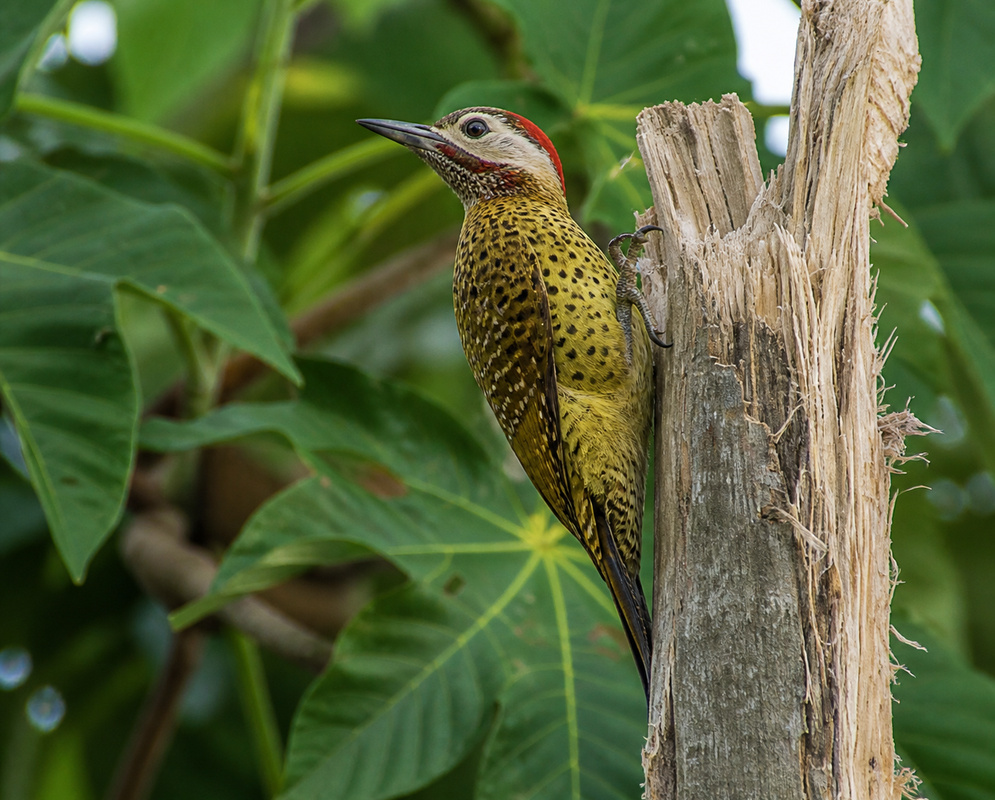


Colaptes punctigula (Spot-breasted woodpecker)
Colaptes punctigula (Spot-breasted woodpecker) is resident from Panama through much of northern and central South America, including Colombia, Venezuela, the Guianas, Ecuador, Peru, Bolivia, and Brazil. It occupies forest edges, open woodland, savanna with scattered trees, plantations, gardens, and other partly cleared habitats. Adults are approximately seven to eight inches long. The back and wings are barred black and yellow-olive, the pale underparts carry distinct dark spots, and the head combines a red crown with a pale face. Males have a red malar stripe beside the lower bill, while the corresponding marking on females is dark.
The species searches trunks, branches, palms, fence posts, and sometimes the ground for ants, beetles, larvae, and other invertebrates. Its straight, pointed bill is used for probing, tapping, and opening decayed wood rather than for the sustained heavy excavation associated with larger woodpeckers. Pairs excavate a nesting cavity in a tree, palm, or other suitable wooden structure, and both adults participate in nesting duties. The undulating flight alternates several wingbeats with short glides, exposing the contrasting wing pattern. Vocalizations include sharp calls and repeated notes that help pairs maintain contact in open habitat. The IUCN classifies the species as Least Concern because it remains widespread and can use modified landscapes, although local clearing can remove nesting trees. Photographed in Colombia.