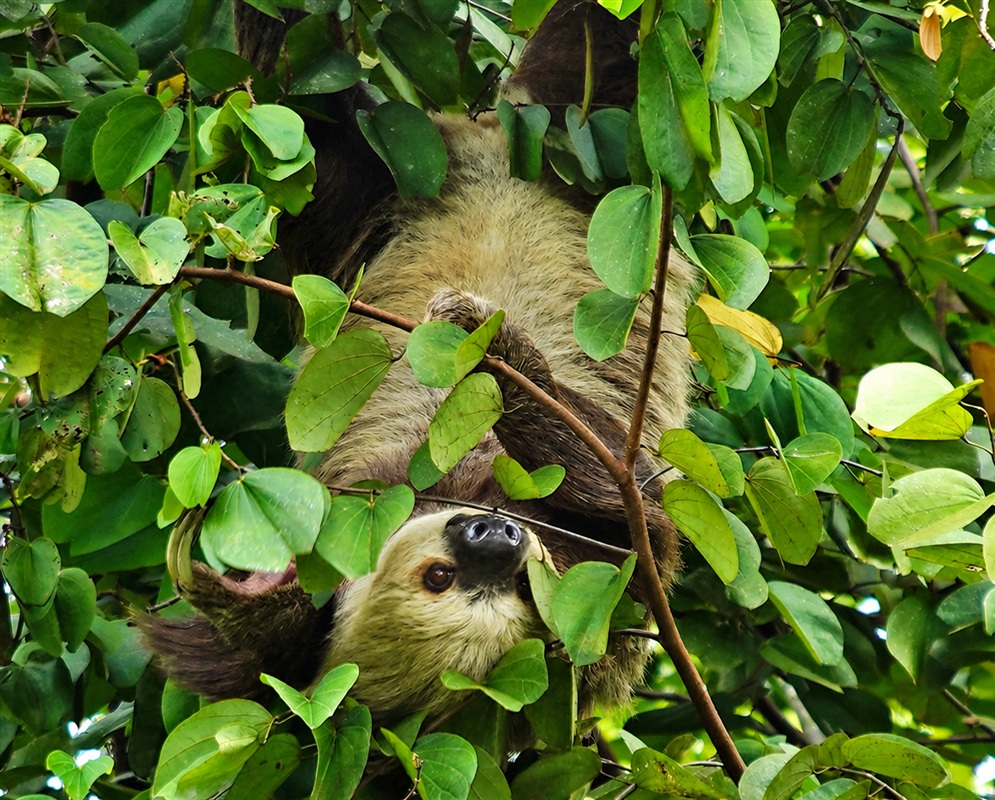


Choloepus hoffmanni (Hoffmann’s two-toed sloth) has two separated populations: one from Nicaragua through western Colombia and Ecuador, and another in the upper Amazon region of Peru, Brazil, and Bolivia. It occupies lowland and montane forest where connected crowns allow movement without descending to the ground. The forelimbs end in two long curved claws, while the hind feet have three; dense fur grows in a direction that helps rain drain away while the animal hangs inverted.
This sloth is mainly nocturnal and usually solitary. It moves slowly through the canopy but is a capable swimmer and can travel quickly for short distances when necessary. Its diet consists largely of leaves, supplemented by buds, fruit, and other plant material. A low metabolic rate and long digestive passage allow it to process fibrous food. Females give birth while hanging and carry the single young against the abdomen. The IUCN lists the species as Least Concern, although forest fragmentation and illegal trafficking create local pressure. Photographed in Colombia.