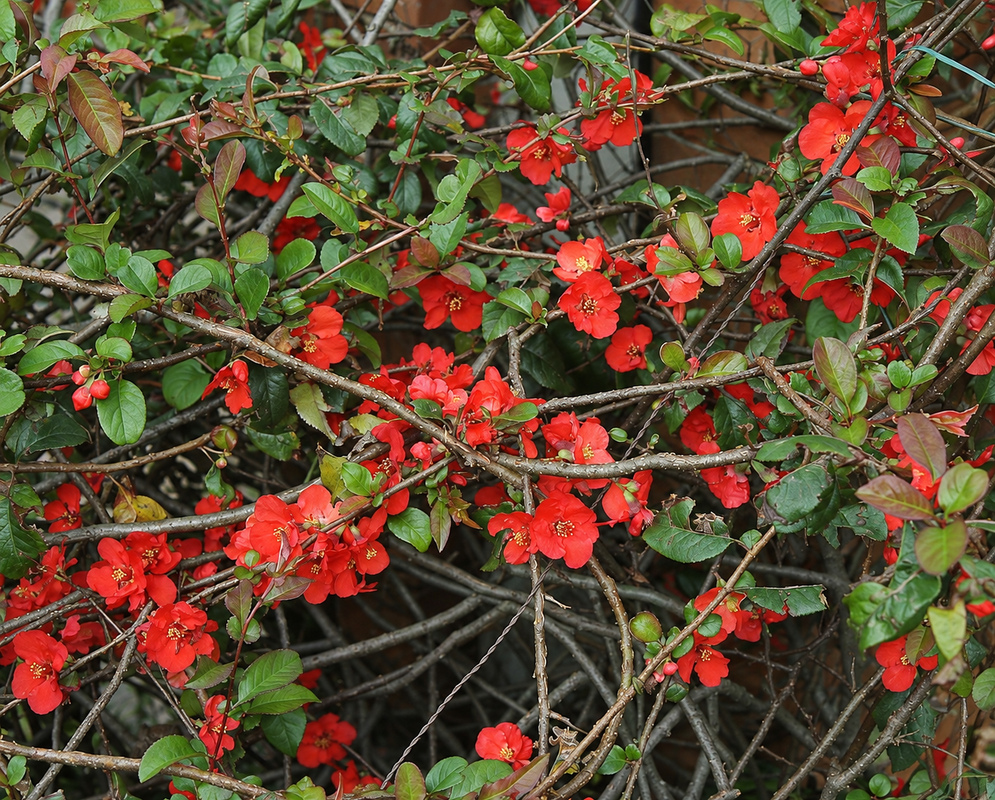

Chaenomeles speciosa (Flowering Quince)
Native to China, flowering quince is a deciduous shrub with a dense tangle of often thorny branches. Its red, pink, or white flowers open on older wood, commonly before the leaves emerge in temperate spring. Single flowers have five petals surrounding numerous stamens, while selected cultivars have additional petals. ‘Geisha Girl’ has semi-double to double apricot-pink blossoms and received the Royal Horticultural Society’s Award of Garden Merit in 2002. ‘Toyo-Nishiki’ can bear red, pink, and white flowers in the same cluster.
The aromatic fruits are hard and sharply tart when raw but are used in cooked jellies and preserves; the seeds contain toxins and are removed from edible preparations. The dried fruit is also the Chinese medicinal ingredient mu gua, traditionally used for muscle cramps, rheumatic joint pain, and vomiting or diarrhea accompanied by spasms. In laboratory research, a polysaccharide fraction from the fruit reduced inflammation and paw swelling in rats with experimentally induced arthritis; those results do not establish an arthritis treatment in people. Flowering quince has naturalized beyond China, including parts of Europe, New Zealand, and the United States. Photographed in Bogotá, Colombia.