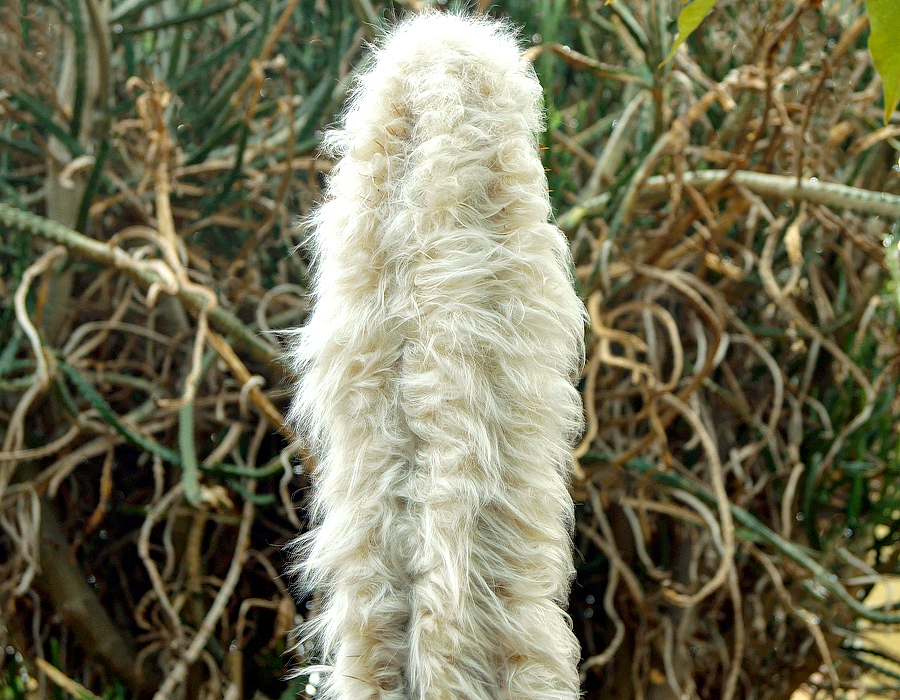


Cephalocereus senilis
Native to the dry landscapes of Hidalgo and Veracruz in Mexico, this columnar succulent cactus is known as old man cactus or viejito. Its shaggy white covering gives young plants the appearance of an unkempt head of hair. These flexible, modified spines reflect intense sunlight and help protect the stem from temperature extremes, while sharper spines lie beneath them. As a plant matures, the lower stem can lose much of its white covering. Flowering often begins only after ten to twenty years.
Mature columns develop a specialized woolly flowering zone along one side of the stem, called a lateral cephalium. The flowers emerge through this dense covering and open at night. The cactus is popular as a collectible ornamental, but illegal collection of young plants and deterioration of its restricted habitat threaten wild populations, which are classed as Endangered. In Mexican traditional medicine, it is also used for digestive complaints. Photographed in Colombia.