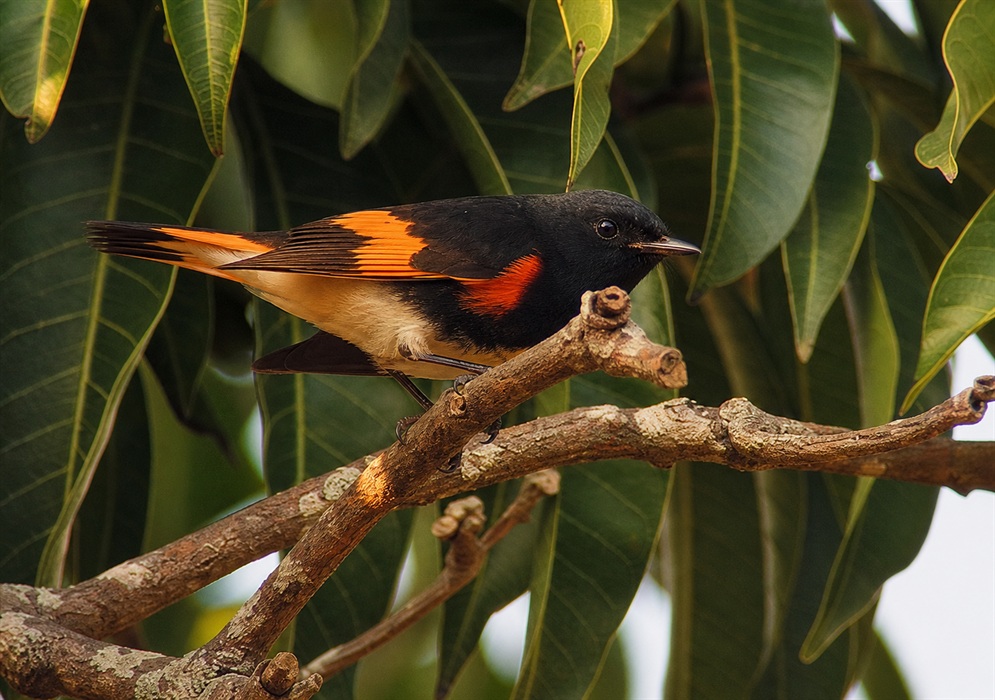


Setophaga ruticilla (American redstart)
Setophaga ruticilla, commonly known as the American Redstart, breeds across much of Canada and the eastern and northwestern United States, then migrates to the Caribbean, Mexico, Central America, and northern South America for the nonbreeding season. In Colombia it occupies forest, woodland edges, shade-grown plantations, mangroves, and other habitats with dense foliage. Adult males are black with orange patches in the wings, flanks, and tail; females and immature birds are grayish olive with yellow patches in the same positions. Adults are about 5 inches long.
This warbler is an active insect hunter. It darts through branches, makes short aerial sallies, and repeatedly spreads its patterned wings and tail, a display thought to startle hidden prey into movement. Flies, moths, beetles, leafhoppers, and other arthropods form most of the diet, while small fruits can become more important during migration and winter. Individuals defend feeding territories on the wintering grounds, and older males often occupy mangroves or other food-rich sites while females and younger birds occur more often in drier scrub. Northbound and southbound journeys may span thousands of miles, exposing the species to habitat conditions across two continents and the Caribbean. It remains widespread and is assessed as Least Concern, although long-term monitoring has recorded regional declines. Photographed in Colombia.