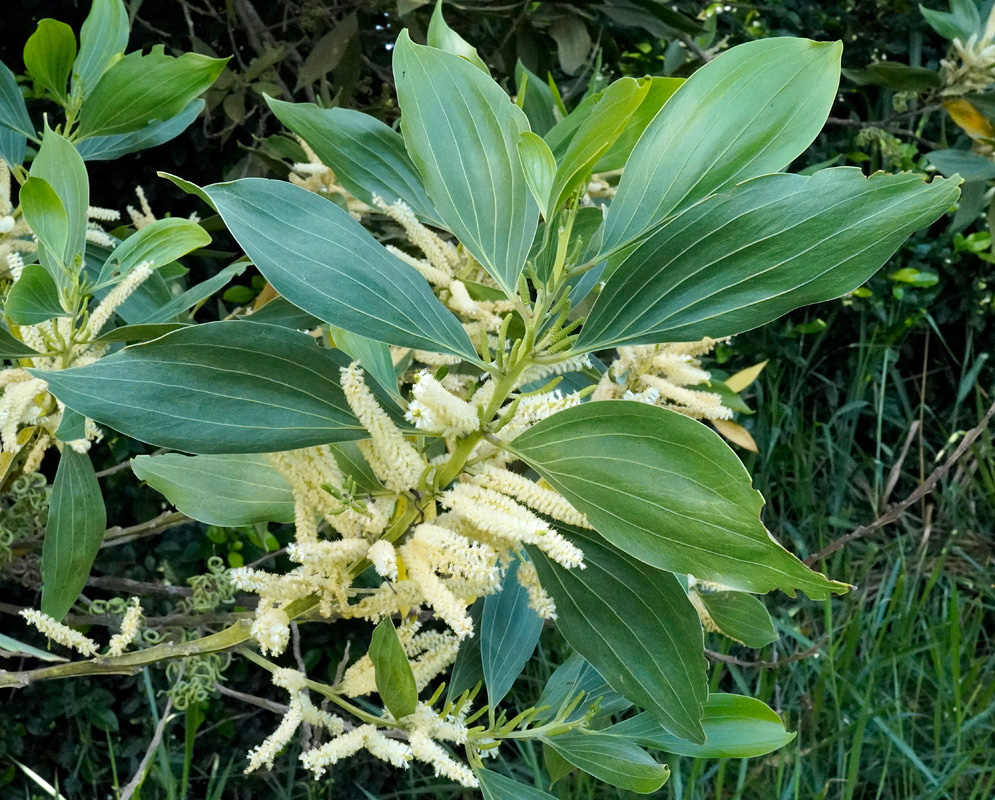


Acacia mangium, commonly known as mangium or black wattle, is native to northeastern Queensland, Australia, the Western Province of Papua New Guinea, and the eastern Maluku Islands of Indonesia. This species typically occupies rainforest margins and disturbed lowland sites, thriving naturally at elevations from sea level to approximately 330 feet, though it can reach up to 2,560 feet. Mangium is a medium to large evergreen tree that typically attains a height of 100 feet with a straight, unbranched bole that can extend over half its total length. The tree has gained significant recognition for its rapid growth in poor, acidic soils, leading to its extensive naturalization in regions such as Puerto Rico, Brazil, and Southeast Asia. It is classified as an invasive species in several areas, including the Pacific Islands, Indian Ocean Islands, and southern Africa.
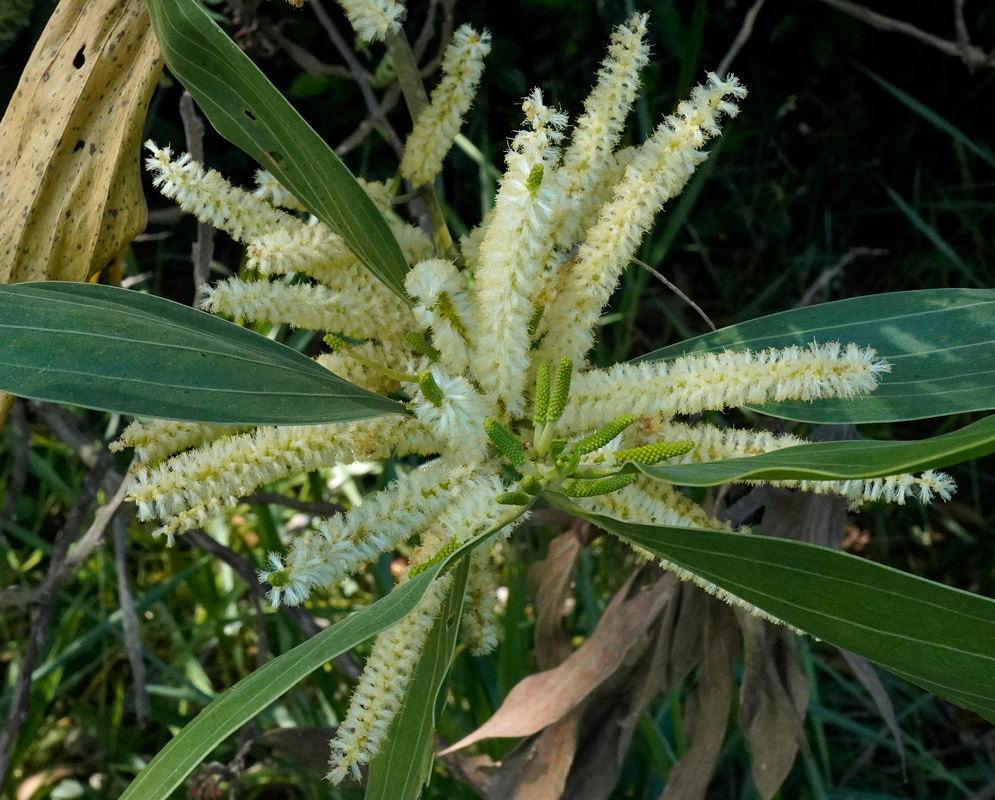
The flowers of Acacia mangium are characterized by their creamy white or pale cream color and are arranged in loose, cylindrical spikes measuring between 2 and 5 inches in length. These spikes appear singly or in pairs within the upper leaf axils. The individual florets are minute, with a calyx approximately 0.03 inches long and a corolla between 0.05 and 0.06 inches. This species readily forms a commercially significant hybrid with Acacia auriculiformis. This hybrid, often called “Acacia hybrid,” is favored in forestry for possessing the superior straightness of mangium and the better wood density and roundness of its parent. Beyond its use in timber, the heartwood is valued for being shimmery, brownish-yellow, and remarkably hard, making it a primary choice for high-end furniture, parquet flooring, and artifacts in Indonesia and Malaysia. In addition to high-quality timber, it is a leading source of short cellulose fibers for the pulp and paper industry, particularly in Southeast Asia.
Traditional medicinal applications of the plant include using extracts from the phyllodes, bark, and pods to treat tropical infections, headaches, and pruritic skin lesions. Scientific studies have further indicated that the bark contains high concentrations of phenolic compounds with antidiabetic and antioxidant potential. While the seeds are considered edible and are traditionally ground into flour or cooked as a vegetable in some regions, they contain toxic substances and require specific preparation to be safe for consumption. Environmentally, mangium is utilized for the rehabilitation of degraded tropical lands and mine spoils, such as open-pit gold mines. Photographed in Antioquia, Colombia.