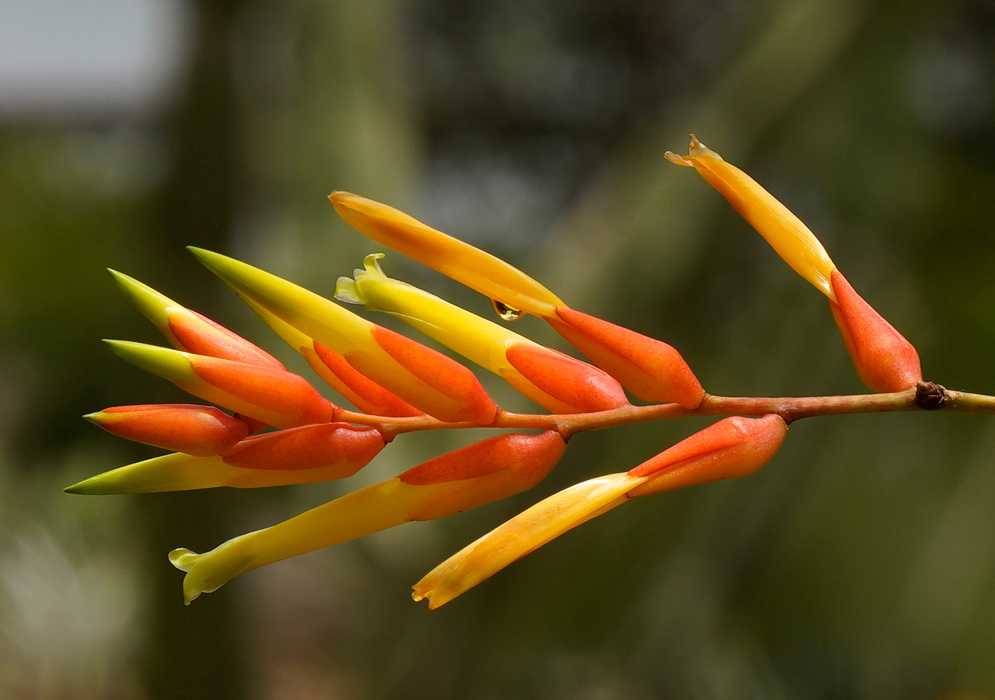


Deuterocohnia meziana
Native to Bolivia, Paraguay, west-central Brazil and northwestern Argentina, it is a perennial bromeliad that grows on rocky outcrops and steep slopes. It forms dense rosettes of tough leaves with spiny margins and spreads by producing clustered offsets. Tall, branched flower stalks carry tubular blooms in orange, reddish or yellow tones, sometimes with green tips. The woody flowering stalks are persistent and can produce new flowers for several years. Small seeds are dispersed by wind, while vegetative growth helps the plant form dense patches on shallow soils. In Brazil, its fragmented rock-outcrop populations are threatened by habitat degradation, including iron mining, fire and grazing. Photographed in Florida.